Email:
info@leachechem.com
Selecting a reliable halogen-based biocide requires a deep understanding of the balance between oxidative power and material compatibility. In industrial water systems, the choice of a bromine-donor agent can dictate the long-term efficiency of cooling towers and the safety of pharmaceutical intermediate synthesis.
The demand for stable, high-purity halogenated hydantoins has grown as operators seek alternatives to traditional liquid bleach or volatile chlorine gas. These organic solids provide a safer handling profile while maintaining the rigorous microbial control necessary for large-scale industrial operations.
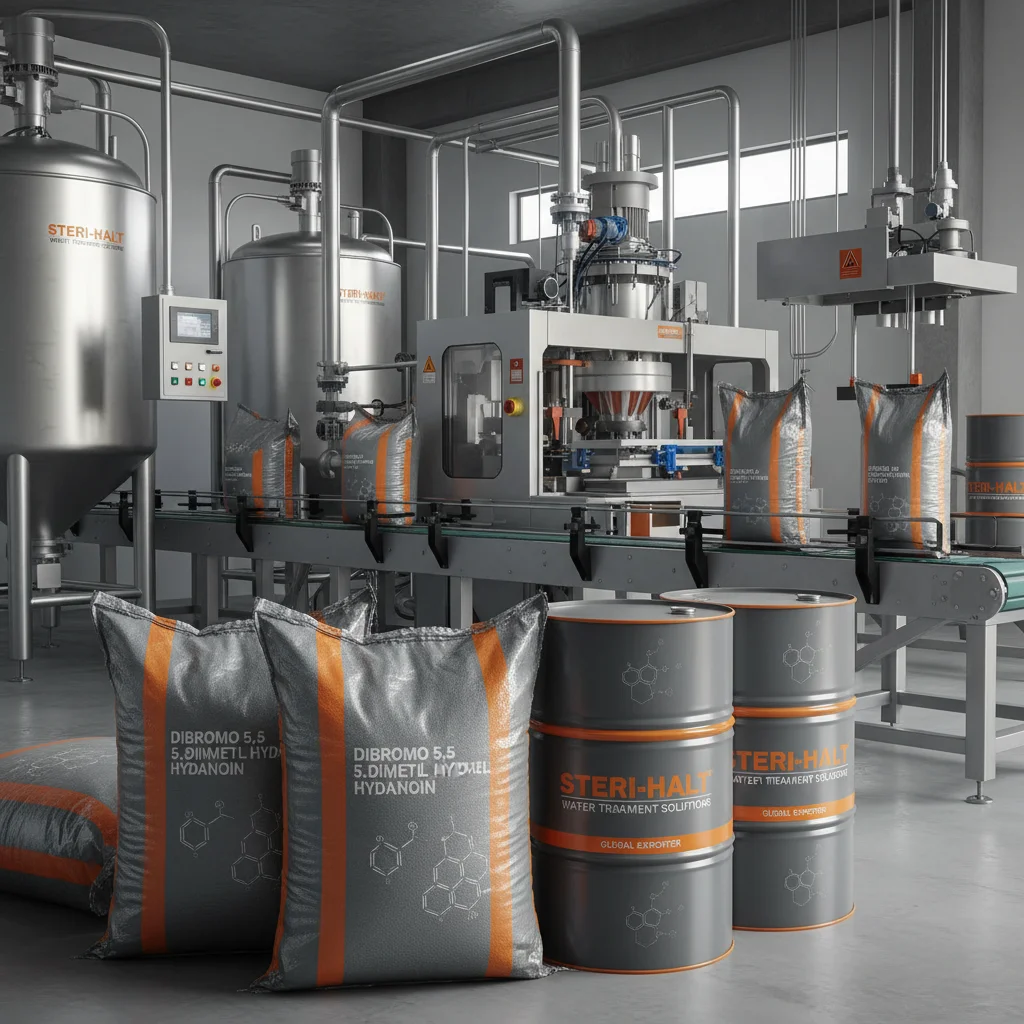
For procurement officers and plant engineers, identifying a qualified Dibromo 5 5 DimethylHydantoin exporter involves evaluating not just the chemical assay, but the supply chain's ability to maintain purity across international shipments.


The efficacy of 5,5-dimethylhydantoin derivatives lies in their ability to act as "reservoirs" for active halogen. By substituting hydrogen atoms with bromine, these compounds create a stable solid that slowly releases hypobromous acid (HOBr) upon contact with water. This slow-release mechanism prevents the "spike and drop" concentration curves associated with liquid disinfectants.
In pharmaceutical manufacturing, these structures serve as critical intermediates. The precision of the bromine placement ensures that subsequent chemical reactions occur with high regioselectivity, reducing the formation of unwanted by-products in the synthesis of active pharmaceutical ingredients (APIs).
The primary driver of biocidal performance is the pH-dependent speciation of the released halogen. Unlike chlorine, which loses significant potency as pH rises above 7.5, bromine remains highly effective in alkaline environments. This makes it the preferred choice for industrial cooling waters where pH is often elevated to prevent corrosion of steel piping.
Another critical factor is the ability to penetrate biofilms. Bromine-based biocides exhibit superior penetration capabilities into the extracellular polymeric substances (EPS) that protect colonies of bacteria and algae. By disrupting the biofilm matrix, these chemicals ensure that the active agent reaches the dormant microbes at the surface of the heat exchanger.
Furthermore, the interaction with Total Dissolved Solids (TDS) must be considered. High TDS environments can sometimes interfere with the solubility of cheaper alternatives, but refined hydantoin series products are engineered to remain stable and active even in high-salinity process water.
Water treatment in petrochemical or food processing plants often involves extreme temperature fluctuations. A key technical challenge is ensuring that the biocide does not decompose prematurely or precipitate out of the solution, which could lead to localized dosing failures and microbial breakthroughs.
The operational superiority of bromine-based systems over chlorine stems from the higher stability of bromamines compared to chloramines, ensuring a longer-lasting residual disinfectant effect in high-load organic environments.
To address these challenges, manufacturers like Leache Chem optimize the crystalline form of their products. By ensuring a consistent bulk density and particle size distribution, they enable the creation of stable aqueous solutions that can be integrated into automated dosing systems without clogging injectors.
When comparing different bromine delivery methods, plant managers often look at the "Active Release Efficiency" versus "Handling Safety." While liquid bromine is highly potent, its extreme toxicity makes it impractical for many sites. Solid hydantoin derivatives provide a balanced profile of high potency and significantly reduced risk.
The following index evaluates common bromine-based precursors across five key operational metrics. These values represent a qualitative assessment of suitability for varied industrial environments.
Integrating a new biocide into an existing water treatment loop requires a phased approach. First, the current microbial load and water chemistry (TDS, pH, and alkalinity) must be baselined. In a typical industrial setting, the transition to a bromine-donor system often reveals a reduction in the frequency of "shock" treatments, as the consistent residual levels provide a more stable defense against Legionella and other opportunistic pathogens.
From a logistics perspective, the move to solid forms simplifies the supply chain. 25 kg polyethylene-lined bags or 1-ton containers reduce the need for specialized hazardous liquid storage tanks, lowering insurance costs and enhancing workplace safety. This logistical shift is particularly beneficial for municipal-industrial hybrid facilities that manage multiple decentralized water loops.
Environmental regulations are increasingly targeting the discharge of halogenated organic by-products. The industry is shifting toward "precision dosing," where the amount of biocide is dynamically adjusted based on real-time sensor data. This prevents over-chlorination and reduces the environmental footprint of the facility.
Modern synthesis routes are also focusing on reducing the use of volatile organic solvents during the production of hydantoin intermediates. By employing more sustainable catalytic processes, manufacturers can provide products that meet the "green chemistry" requirements of the pharmaceutical and aquaculture sectors.
The future of water treatment lies in the synergy between high-efficiency chemicals and automated monitoring. The objective is no longer just "sterilization," but the maintenance of a biological equilibrium that prevents corrosion and scaling while ensuring human health and safety.
When sourcing from a Dibromo 5 5 DimethylHydantoin exporter, the technical data sheet (TDS) is only the starting point. Buyers must verify the consistency of the product's purity and the manufacturer's ability to adhere to international hazardous material regulations (IMDG/IATA) to avoid costly customs delays.
A critical part of the evaluation is the "Stability-to-Cost" ratio. While lower-purity products may seem cost-effective, they often introduce more impurities into the water system, potentially leading to increased scaling or interference with other water treatment chemicals like ion-exchange resins.
The following framework provides a relative assessment of the trade-offs involved in different procurement strategies for bromine-based chemicals.
| Evaluation Factor | Liquid Bromine | Halogenated Solids | Chlorine-Based |
|---|---|---|---|
| Handling Risk | Extreme (Toxic) | Low (Stable Solid) | High (Gas/Liquid) |
| Alkaline Efficacy | Excellent | Excellent | Poor |
| Storage Footprint | Large (Specialized) | Compact (Bags/Tons) | Moderate |
| Biofilm Penetration | High | High | Moderate |
| Logistics Cost | High (Hazmat) | Moderate | Moderate |
| Application Ease | Complex Dosing | Simple Feeders | Automated/Manual |
The primary difference is efficacy at higher pH levels. Chlorine loses its biocidal power as water becomes more alkaline, whereas bromine remains active. Additionally, bromine is more effective at penetrating biofilms and produces bromamines, which are more potent disinfectants and less irritating than the chloramines produced by chlorine.
Halogenated hydantoins should be stored in a cool, dry, and well-ventilated area away from direct sunlight and combustible materials. They must be kept in their original moisture-resistant packaging—typically polyethylene-lined woven bags—to prevent premature degradation caused by humidity or atmospheric moisture.
Yes, these compounds are widely used as brominating agents in the pharmaceutical industry. Their advantage lies in the controlled release of bromine, which allows for higher regioselectivity during the synthesis of API intermediates, reducing the need for extensive purification steps to remove isomer by-products.
A quality exporter should provide a comprehensive Certificate of Analysis (CoA) verifying purity (e.g., ≥99.7% for precursors), precise bulk density, and low heavy metal content. They must also demonstrate strict compliance with IMDG and IATA regulations for international hazardous material transport to ensure product integrity during transit.
While all halogens can be corrosive, bromine-based systems are often less aggressive toward certain metals than high-concentration chlorine systems, especially when managed with a proper corrosion inhibitor. The slow-release nature of hydantoin derivatives prevents the extreme concentration spikes that typically accelerate metal pitting.
Dosing should be based on the organic load and the desired residual bromine level (typically 0.5 to 2.0 ppm). It is recommended to start with a baseline microbial test and gradually increase the feed rate while monitoring the ORP (Oxidation-Reduction Potential) to ensure the system is protected without over-dosing.
The transition from basic chlorination to advanced bromine-donor systems represents a strategic move toward operational stability and safety. By leveraging the unique chemical properties of halogenated hydantoins, industrial facilities can achieve superior microbial control with lower logistical risks and enhanced material compatibility.
As the industry moves toward more sustainable and automated water treatment, the role of high-purity chemical precursors becomes even more critical. Selecting a partner who combines manufacturing expertise with a rigorous understanding of international supply chain requirements is the final, and most important, step in ensuring system reliability.